The most expensive habit in lead generation is worshipping the lowest CPL. Across final expense, Medicare, debt relief, and home services, payroll is paid by cost per sale — or cost per booked job, enrollment, or qualified appointment. Exclusive inventory often looks more expensive on day one and cheaper on the P&L.
This guide gives US buyers a clean framework to compare exclusive vs shared leads, design a pilot that measures the right outcomes, and avoid vendor theater. Related: final expense, roofing, debt, Medicare, TCPA.

The basic math
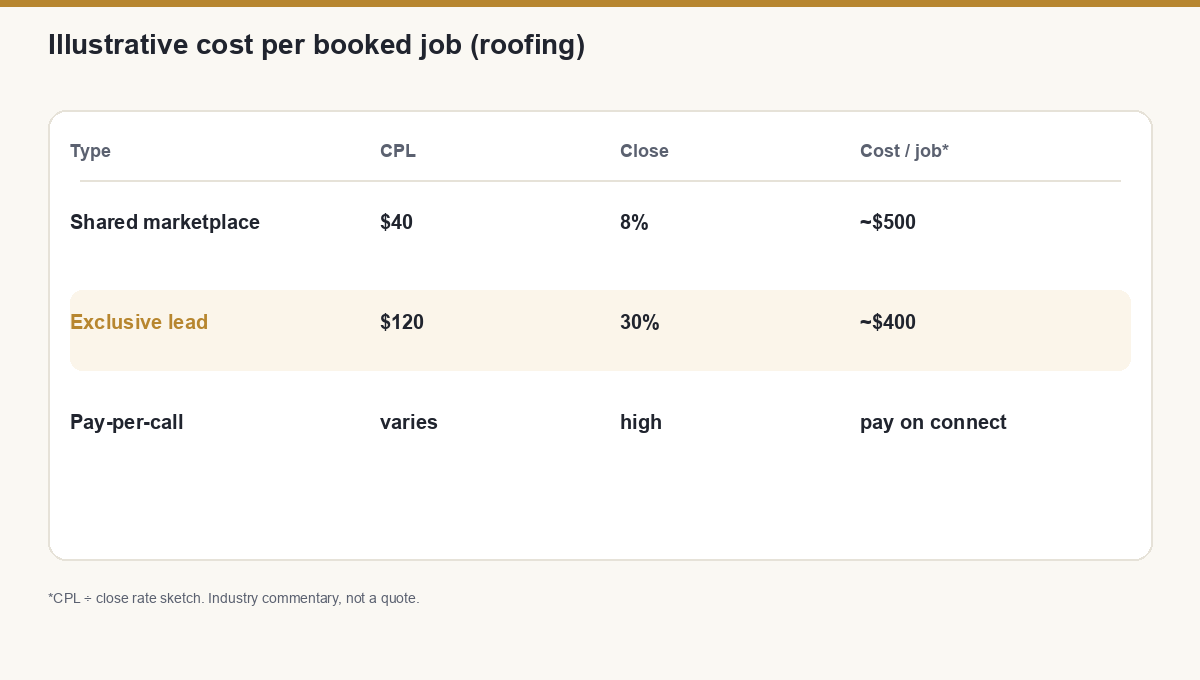
Cost per sale ≈ CPL ÷ close rate, then add agent labor, no-contact waste, and fulfillment cost. If you only compare CPL, shared always looks like a bargain and exclusive always looks expensive. That is how teams talk themselves into bad inventory.
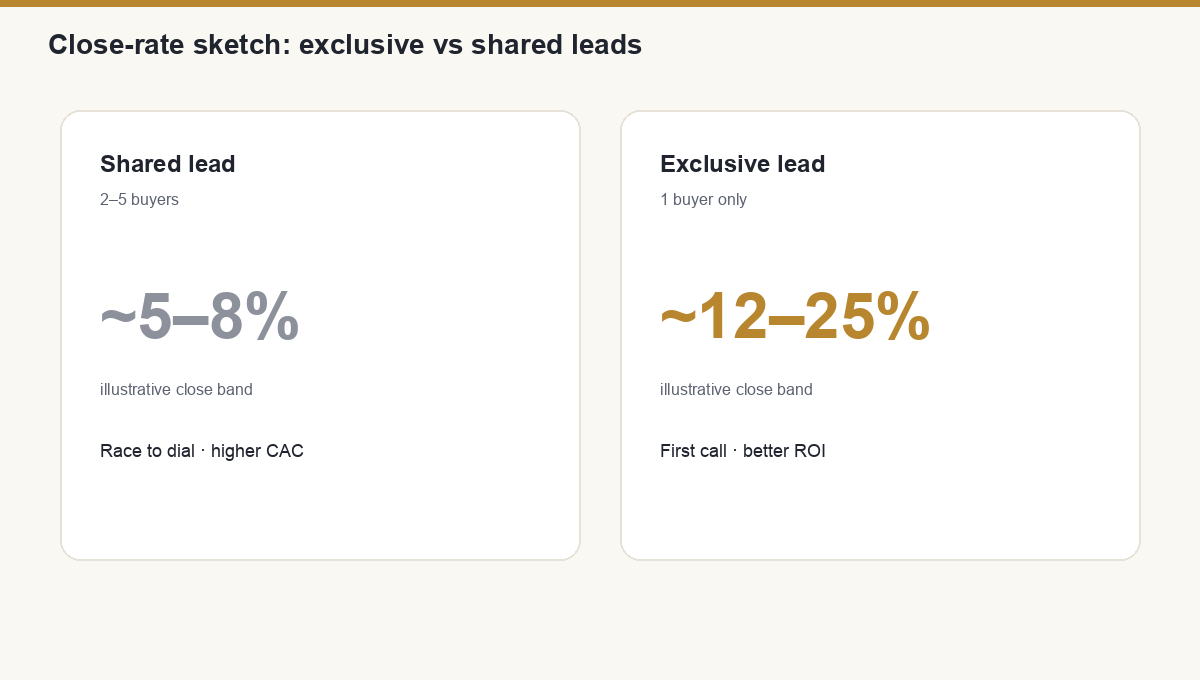
| Metric | Shared tendency | Exclusive tendency |
|---|---|---|
| CPL | Lower | Higher |
| Contact rate | Lower (multi-dial competition) | Higher when speed is real |
| Agent minutes per sale | Higher | Often lower |
| Cost per sale | Often worse than CPL suggests | Often better than CPL suggests |
| Consumer experience | Multiple sellers calling | One professional path |
Same structure applies to insurance, debt, and home services with different close rates and payoffs. Always plug in your numbers.
Why exclusive can win at a higher CPL
Shared leads multi-dial the same consumer. Contact rates fall; agent minutes rise; brand experience collapses. Exclusive raises the odds you are first and only. Industry education often claims exclusive close rates can roughly double shared in some FE contexts — treat that as a hypothesis. Prove it on your pilot program.
Exclusive also reduces “ghost competition” costs: the hours your team spends chasing people who already bought from someone else who called first. Those hours rarely appear in a CPL report and always appear in payroll.
SKU strategy beats bulk discount strategy
- Premium exclusive web for core production
- Live transfer for peak staffing windows
- Aged only as a labeled overflow layer
Negotiate by geo and SKU, not only a headline discount. Ten percent off the wrong ZIPs is not a win. A clean exclusive feed in your best states at a fair price beats a national dump at a “deal.”
Compliance is part of ROI
A cheap lead that creates a TCPA claim is not cheap. Budget for consent quality the way you budget media. Packet requirements: consent record guide. Braqon’s commercial standard is exclusive inventory with documentation — because un-documentable contacts are contingent liabilities, not assets.
Include complaint handling time, replacement lag, and brand damage from multi-seller pile-ons. If your model ignores them, shared will always look artificially attractive.
How to run a pilot that produces decisions
- One primary SKU and limited geos
- Daily caps matched to real capacity
- Frozen script for the measurement window
- Pre-written success thresholds (contact, close, cost per sale)
- No simultaneous change of vendor, offer, and team process
A pilot program is paid and scoped. It is not a free sample bin. The output should be a decision: scale, adjust, or stop — with numbers finance will accept.
Scorecards serious buyers keep
- Leads delivered, accepted, replaced
- Median time to first attempt
- Contact rate (24h and 72h)
- Qualified rate / appointment rate
- Close or enrollment rate
- Cost per sale and contribution margin
- Complaint and opt-out rate by source
If a vendor cannot support these fields in reporting, you will manage by anecdote. Anecdotes do not survive budget season.
A simple model finance will accept
Build a one-page model:
- CPL by SKU
- Expected contact rate and close rate bands (low/base/high)
- Labor minutes per attempt and per sale
- Fulfillment or fulfillment-adjacent cost
- Contribution per sale after media and labor
Run exclusive and shared side by side with honest rates — not aspirational exclusive rates and despair shared rates. Update the model with pilot data before signing annual volume.
Reading vendor dashboards without being misled
Dashboards love vanity metrics: impressions, raw leads, “interest scores.” Translate everything into your funnel. Ask how the vendor defines exclusive, qualified, and billable. Ask what happens to leads you reject. Ask whether rejected leads are resold.
Be skeptical of blended averages that hide one terrible geo inside a national feed. Segment by state and by week. Trends beat single-week snapshots.
When shared inventory can still have a role
Some teams use shared as overflow when exclusive supply is capped and agents would otherwise sit idle — fully aware of the economics. That can be rational. What is not rational is building the core production engine on shared while calling it a strategy. If shared is overflow, label it overflow in the budget.
Quarterly re-underwriting of every source
Lead sources decay. Publishers change. Creative fatigues. Re-underwrite quarterly: cost per sale, complaint rate, and operational fit. Cut sources that fail even if the relationship is old. Keep sources that win even if CPL ticked up.
Write decisions down after each pilot or quarter: what scaled, what paused, and why. Institutional memory is a competitive advantage in lead buying.
Worked examples you can copy into a spreadsheet
Example A — shared: $25 CPL, 8% close rate → ~$312 media cost per sale before labor. If agents need many more attempts, labor may add another large slice. Example B — exclusive: $55 CPL, 18% close rate → ~$306 media cost per sale before labor, often with fewer minutes per sale. The winner is not obvious from CPL alone; it becomes obvious when you add labor and complaint costs.
Rebuild the examples with your real close rates. If exclusive only matches shared on media cost per sale but saves two agent hours per sale, exclusive still wins. If exclusive cannot beat shared even with optimistic rates, fix process or change vendor before you declare the category dead.
Revisit the model quarterly. Source quality and team skill both move. Static spreadsheets become fiction.
Labor cost: the variable CPL reports hide
Two sources can show similar cost per sale on media alone while producing very different payroll outcomes. Shared leads often require more attempts, longer cycles, and more “already bought elsewhere” conversations. Exclusive leads often compress the path when speed and intent are real.
Track average handle time and attempts-to-contact by source for two weeks. Multiply by fully loaded agent cost. Add that to media cost per sale. The ranking of sources frequently changes after this step — which is the point of adult ROI analysis.
Include manager time for firefighting bad inventory. If one shared source creates daily Slack chaos, it has a real cost even when CPL looks cute.
Margin floors and when exclusive is the wrong buy
Exclusive is not a religion. If your gross margin per sale cannot support premium CPL even at optimistic close rates, you need a different offer, a different labor model, or a different channel — not motivational posters about exclusivity. Run the math honestly. Sometimes the business must change before the media can.
Conversely, if margins are healthy and shared marketplaces are burning brand and agent morale, exclusive can be cheap relative to the organizational damage of constant price races and multi-seller pile-ons.
Portfolio thinking: core, test, and overflow
Think in portfolios. Core: exclusive SKUs that fund the business. Test: small budgets for new geos or formats with hard kill criteria. Overflow: explicitly labeled secondary inventory when core is capped and labor would idle. Mixing these without labels creates fake debates in leadership meetings.
Assign owners. Core needs a performance owner and a compliance owner. Test needs a time box. Overflow needs a cap. Review monthly.
Communicating ROI to non-marketers
Owners and finance leaders do not need affiliate jargon. Show three numbers: cost per sale, contribution after labor, and complaint rate. Show exclusive vs shared side by side. Show the pilot design and the decision rule. When leadership trusts the measurement, you stop re-litigating CPL every week.
Bring a one-page appendix with definitions: what exclusive means, what close rate means, what a complaint means. Definition fights are how good analyses die in meetings.
Sensitivity analysis beats single-point forecasts
Always show low/base/high close rates for exclusive and shared. Single-point forecasts create false confidence and ugly postmortems. If exclusive wins in base and high but loses in low, your pilot must specifically test whether you can clear the low-case threshold with process improvements.
Document assumptions in plain language next to the grid. Future you will not remember why you believed an 18% close rate in March.
Cohort analysis: judge leads by week, not by vibes
Group leads by delivery week and follow them to sale for a fixed horizon (for example, 14 or 30 days). Compare exclusive cohorts to shared cohorts on contact, close, and cost per sale. Weekly cohorts defeat the classic bias of remembering last Tuesday’s bad shift as if it were a quarterly truth.
Look for stabilization. First-week exclusive results can be noisy while agents adapt. Third-week results after process stabilization are more decision-useful. Build that expectation into pilot length.
Attribution honesty when multiple channels touch the sale
If consumers also see your brand ads, organic search, or referrals, do not assign 100% credit to the last exclusive lead by default — and do not assign 0% either. Use simple rules consistently. The goal is directional source management, not academic multi-touch perfection in month one.
What you must avoid is changing attribution rules mid-pilot to make a preferred vendor win. Pick a rule, write it down, live with it until the pilot ends.
Vendor negotiations using cost-per-sale language
Negotiate like an operator. Instead of only asking for a lower CPL, ask for better geo mix, faster replacements, stronger consent packets, or improved transfer qualifications that move cost per sale. Sometimes a flat CPL with better fit beats a discounted CPL with worse fit.
Share enough data to be credible without handing over your entire P&L. Vendors respond to buyers who measure. Bring contact rate and close rate by week. Leave theatrics at home.
Practical FAQs about exclusive vs shared ROI
What if leadership only wants the lowest CPL? Translate to cost per sale and labor. If leadership still insists on lowest CPL after seeing contribution margin, you have a strategy conflict — not a spreadsheet error.
How many leads do I need for a meaningful pilot? Enough to see stable contact rates and a usable number of sales outcomes. Exact counts vary by close rate; decide thresholds with finance before you start.
Can shared ever beat exclusive on cost per sale? Yes, in some operations and geos. That is why pilots exist. The error is assuming shared wins because CPL is lower, or exclusive wins because the slogan sounds premium.
Should compliance costs be in the ROI model? Yes — at least as a risk-adjusted cost or as a hard constraint (no scale without packets). Pretending compliance is free is how expensive surprises arrive.
Putting it together: a 30-day decision loop
Days 1–3: freeze definitions (exclusive, close, complaint), build the spreadsheet, set pilot caps. Days 4–24: run exclusive and — if needed — a labeled shared control with no midstream chaos. Days 25–30: cohort the results, add labor, review compliance friction, decide scale/adjust/stop.
Then schedule the next loop. ROI is not a one-time whitepaper; it is an operating cadence. Buyers who revisit cost per sale monthly outperform buyers who argue about CPL emotionally whenever a shift goes badly.
When the pilot ends, archive the spreadsheet with the decision and the date. Future debates should start from that artifact. Organizations that cannot find last quarter’s cost-per-sale work are doomed to rebuy the same arguments with new vendors.
Where Braqon fits
Braqon sells exclusive leads across final expense, roofing, debt relief, and Medicare — with consent documentation and pilot-first commercial design. Explore the US hub, vertical pages, and FAQ when you are ready to model a pilot against your real close rates.
Bring your current CPL, contact rate, close rate, and labor cost per hour. With those four inputs we can talk honestly about whether exclusive inventory improves cost per sale in your operation.