Medicare lead buying is seasonal, high-value, and heavily watched. Agencies that win Annual Enrollment Period do it with planning, exclusive inventory, staffed phones, and consent discipline — not last-minute shared lists.
This guide covers exclusive Medicare and Medicare Advantage lead buying, AEP operations, TCPA awareness, and how to structure a pilot before peak. Product: Medicare leads. Pair with final expense if agents write both senior products. Consent deep dive: TCPA consent records.
AEP multiplies volume. It should not multiply sloppy consent. Plan staffing and documentation before you plan media spend.

Seasonality without mythology
AEP (October 15 through December 7) concentrates a large share of annual Medicare shopping. Demand and prices typically rise into the fall. SEP and turning-65 activity still matter outside AEP. A program that only exists for ten weeks creates staffing whiplash — plan on a twelve-month calendar even if spend peaks in Q4.
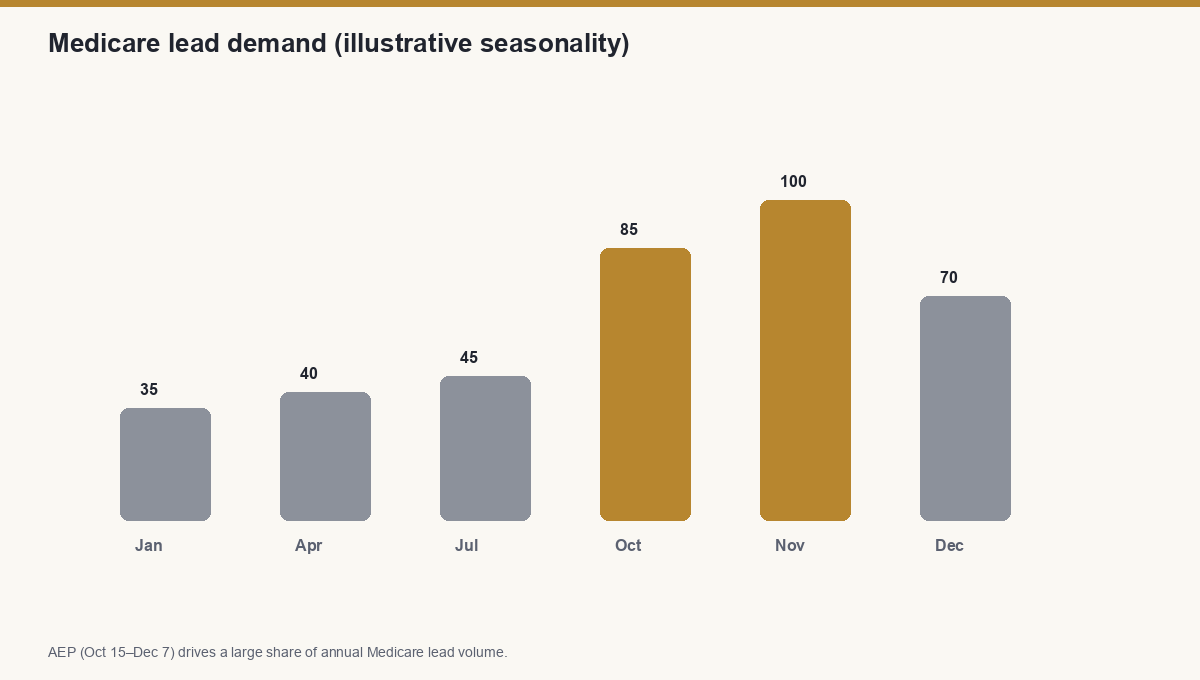
Operationally, September is for systems: CRM webhooks, license routing, call recording policies, and vendor pilots. October is for execution. Agencies that start vendor shopping in mid-October usually buy whatever is left — often shared, often expensive, often poorly documented.
Exclusive Medicare leads vs shared senior lists
Shared senior leads create multi-agent pile-ons and a poor beneficiary experience. Exclusive sell-out is the professional standard for teams that care about retention and brand. Higher CPL can still win on cost per enrollment when contact and close rates improve. See ROI math.
Exclusive does not mean “any senior.” Intent should match the offer: Medicare Advantage information, plan comparison, or related shopping intent — not a free gift card quiz with a buried checkbox. Soft traffic can be tested; it should not be your AEP backbone.
Compliance: TCPA still applies when CMS is watching
Medicare marketing sits under TCPA and CMS marketing rules. Demand consent records, DNC scrubbing, and honest channel scope. Details: consent record guide.
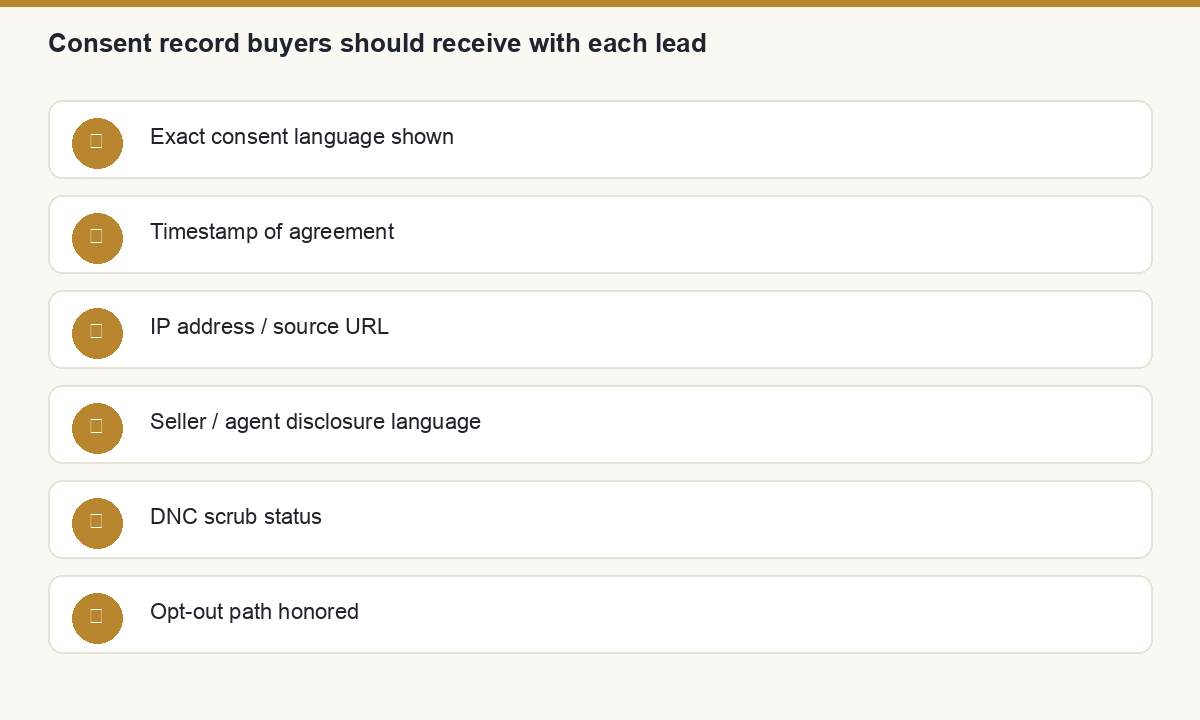
If you cross-sell final expense, do not assume a Medicare form consent automatically authorizes every other senior pitch. Language must match the offer. Keep product conversations aligned to what the beneficiary agreed to receive.
Review complaint and opt-out rates weekly in October and November; throttle sources when friction rises. Peak season is exactly when weak publishers try to push volume.
Formats that fit Medicare teams
- Exclusive web leads for scalable digital intent and CRM control
- Live transfers when licensed agents can take conversations immediately
- Aged only as a labeled, lower-cost layer — not as fake exclusive
Live transfers during AEP require ruthless staffing honesty. If agents are already at capacity on web leads, adding transfers without seats is how you burn premium inventory. Publish availability windows to vendors and measure missed-transfer rates daily at peak.
AEP operating checklist
- Confirm licenses, appointments, and routing by state
- Test webhook latency during a pilot — not in week two of November
- Freeze core scripts for the first peak week so you can measure inventory
- Set daily caps by team capacity, not by ambition
- Document replacement rules and after-hours handling
During AEP, run a daily stand-up: delivery volume, contact rate, transfer miss rate, enrollment rate, and compliance exceptions. Escalate source problems same day. Waiting a week in November is how bad inventory empties a budget.
License, appointment, and routing before media
Media cannot fix broken routing. If leads for State A land on agents not appointed for State A, you will invent “bad lead” stories that are really operations stories. Build routing tables first. QA them with sample leads. Re-test after any CRM change.
For IMOs and FMOs, downline distribution rules need the same rigor. Exclusive inventory diluted across unprepared agents becomes shared-quality outcomes with exclusive prices.
Transfer floors during peak weeks
Peak weeks punish vanity staffing charts. Schedule to call arrival curves, not to average headcount. Cross-train overflow agents where licensing allows. Keep a simple escalation path when wait times exceed your standard.
Define billable transfer criteria with vendors before peak: duration, geography, intent questions asked, and consent confirmation. Ambiguity at peak becomes dispute season in January.
Beneficiary experience is a growth channel
Medicare shoppers remember how they were treated. Exclusive contact still fails if the first call is confusing, rushed, or misaligned with the form they submitted. Open with context. Confirm permission to discuss plan options. Respect do-not-call and opt-out immediately.
Happy enrollments reduce chargebacks and complaints. That is not soft marketing talk — it is cost control in a watched vertical.
After AEP
January should not be a cliff. Capture what worked: states, sources, scripts, time-of-day, transfer vs web mix. Keep a lighter year-round exclusive program for SEP and turning-65 so your team does not relearn everything every fall.
Post-AEP is also when you renegotiate based on real data. Bring scorecards. Vendors respect buyers who measured. Update your model with pilot and peak data before signing the next heavy commitment.
Turning-65 and SEP: the quiet capacity builders
Teams that only exist for AEP relearn painful lessons every October. A lighter year-round exclusive program for turning-65 and SEP traffic keeps agents sharp, keeps CRM integrations tested, and gives you vendor performance history before peak pricing. Volume will be smaller; operational value is large.
Use off-peak months to improve routing, consent storage, and script quality. Then AEP becomes a volume ramp on a proven machine — not a cold start under maximum regulatory and competitive pressure. Exclusive Medicare leads reward that discipline more than they reward last-minute panic buying.
Coordinate FE cross-sell rules in writing so peak season does not invent consent edge cases on the fly.
Building the pre-AEP calendar month by month
July–August: confirm vendor shortlist, run small exclusive pilots, validate consent packets, fix CRM fields, and train agents on current year’s talk tracks. September: lock daily caps, publish transfer schedules, complete license/appointment audits, and freeze core measurement scripts. October–early December: execute, review daily, throttle bad sources same day. January: scorecard, renegotiate, keep SEP/turning-65 exclusive baseline alive.
Teams that skip July–September end up buying panic inventory. Exclusive Medicare leads are easier to secure and easier to trust when you are not negotiating under peak pressure with incomplete data.
Share the calendar with leadership. AEP is not only a marketing event; it is a capacity event for licensed labor. Hiring and contracting temporary licensed help belongs on the same timeline as media.
Data fields that make Medicare leads operable
Name and phone are not enough. Useful exclusive Medicare leads often include ZIP, preferred contact time when captured, and clear intent language. Store consent fields with the lead ID. Map county or ZIP to agent assignment rules before peak — not with a spreadsheet heroics plan in week one of AEP.
Test bad-data rates early. High wrong-number rates in September are a gift; the same rates in November are a budget fire. Demand replacements quickly and track vendor latency on credits.
Coaching for beneficiary-first conversations
Medicare shoppers can be confused by plan complexity. Exclusive contact is a privilege; use it to clarify, not to rush. Teach agents to confirm the reason for the call, check understanding, and avoid overloading the first conversation with every possible plan detail. Follow-up appointments often close better than marathon first calls.
Monitor complaint themes weekly. If multiple beneficiaries say they did not request a call, stop the source and investigate capture paths immediately. Peak volume is not an excuse to slow compliance response.
IMO and FMO distribution without destroying exclusivity
When exclusive leads are distributed to downline agents, enforce speed and training standards contractually. An exclusive lead given to an unresponsive agent becomes a shared-quality outcome. Use SLA rules: first attempt within X minutes, dispositions logged, leads reclaimed if untouched.
Provide a simple agent scorecard visible to field leaders. Exclusivity is a supply-chain property; distribution quality is an operations property. You need both.
Post-call documentation that protects peak-season velocity
Speed matters in AEP, but so does documentation quality. Agents should log plan discussion outcomes, follow-up times, and consent-related notes consistently. Clean CRM data lets managers reassign untouched exclusive leads quickly — the operational twin of vendor exclusivity.
Build a midday reclaim process in November: any exclusive lead with no attempt by a set time returns to a central queue. Exclusivity without internal SLA is just a purchase order.
Creative fatigue and exclusive supply through the fall
Even exclusive publishers feel creative fatigue by late November. Expect quality variance across the AEP window. That is why weekly source scorecards beat a single October judgment. Be ready to shift budget toward sources that hold contact and enrollment rates as the season ages.
Keep a reserve of tested exclusive capacity rather than spending 100% on day one of AEP. Early data should reallocate money. Rigid POs that cannot move mid-season are self-imposed handicaps.
Remote agents, call recording, and peak QA
Remote and hybrid Medicare teams need stronger QA because managers cannot overhear floor energy. Sample calls daily at peak. Score for consent-aligned openings, needs analysis quality, and pressure tactics. Exclusive inventory multiplies whatever behaviors your agents already have — good or bad.
Ensure recording and retention policies are clear before October. You do not want a mid-AEP debate about whether QA can access calls while enrollment volume is exploding.
Beneficiary accessibility and channel choice
Some beneficiaries prefer phone; some prefer scheduled callbacks; some struggle with fast talkers. Train agents to adapt pace. Exclusive leads from digital forms often include people who are comparing options carefully — not only impulse responders. Treat them accordingly.
If you use SMS for appointment reminders, confirm consent scope first. Peak season is the worst time to invent a texting program on top of call-only capture language.
Practical FAQs for Medicare agencies
When should we lock exclusive AEP capacity? Earlier than feels comfortable — ideally after summer pilots, not after the first cold week of October panic.
Are live transfers worth it during peak? They can be, if licensed agents can answer. They are expensive waste if your queue already overflows with web leads.
Can we use the same consent expectations as final expense? The documentation mindset is the same; the offer language and CMS-related marketing constraints are not identical. Keep packets and scripts product-specific.
What is the biggest non-media AEP failure mode? Routing and staffing. Perfect exclusive leads assigned to the wrong agent or to voicemail will not save the season.
Budget pacing across the AEP curve
Spending evenly every day of AEP is rarely optimal. Early weeks may reward higher exclusive investment while agent energy is high and beneficiaries are actively shopping. Late weeks may require stricter quality filters as residual traffic softens. Pace with scorecards, not with equal daily dollars for their own sake.
Keep a contingency reserve for sources that prove out mid-season. The worst outcome is identifying a winning exclusive path on November 10 with no budget left to expand it. Equally bad is spending the reserve on untested shared dumps because of FOMO.
Document pacing decisions weekly so next year’s team inherits a playbook instead of folklore.
One last operational note: treat vendor business reviews during AEP as short and frequent, not long and rare. A fifteen-minute twice-weekly review with contact rates, enrollment rates, and consent exceptions beats a single postmortem in January when budgets are already spent. Exclusive Medicare programs reward teams that manage mid-flight.
If your leadership team only engages with Medicare media in October, export a one-page September readiness report anyway: seats, licenses, pilot results, and open compliance items. Visibility before peak prevents emergency decision-making when prices and tempers are highest.
Where Braqon fits
Braqon offers exclusive Medicare leads with consent documentation and delivery options built for agency operations. Start with a pilot program before peak volume, then scale into AEP with eyes open. See Medicare leads, US FAQ, and the US hub.
If AEP is on your calendar, scope a pilot now around licensed states and agent seats. Peak media without pilot data is how teams buy hope at premium prices.