Every serious US lead buyer eventually learns the same lesson: a lead without a producible consent record is not an asset. It is a contingent liability. Whether you buy final expense, Medicare, debt relief, or home-services leads, TCPA-minded buying means you can show what the consumer agreed to, when, where, and for which channels.
This guide is for operators, agency owners, and compliance-minded sales leaders. Vertical pages: Final Expense, Medicare, Debt Relief, Roofing. Hub: Braqon US. Economics of clean inventory: exclusive vs shared math.
If you cannot show the agreement, you do not have a defensible marketing contact — regardless of how “hot” the lead felt on day one.

What a usable consent record contains
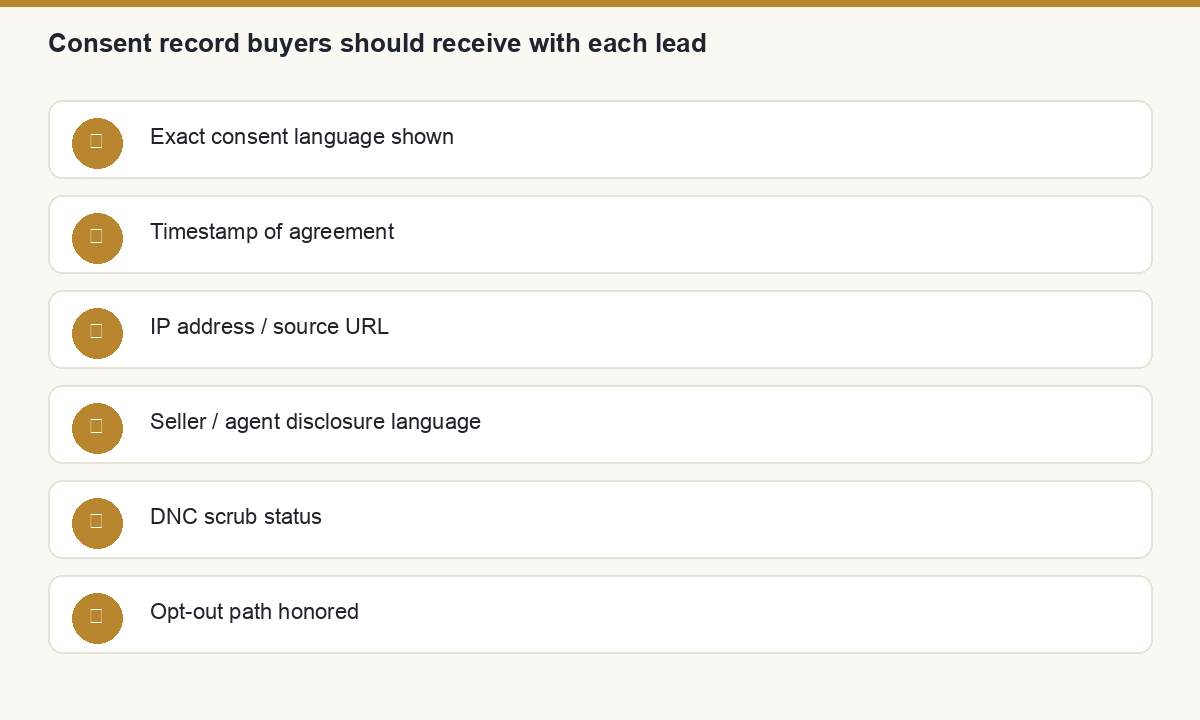
Minimum packet sophisticated buyers already request:
- Exact language displayed to the consumer
- Timestamp of agreement
- IP and/or device metadata when web-captured
- Source URL, campaign, or publisher path
- Clear disclosure that sellers or agents may contact them
- Channel scope: call, SMS, email as applicable
- Evidence that opt-outs are captured and honored
If a vendor cannot provide a sample packet on ten leads, you are not looking at a paperwork gap. You are looking at a product gap. Marketing one-pagers that say “TCPA compliant” without artifacts are advertising, not evidence.
For context on federal telemarketing rules, buyers often review public materials from the FCC on unwanted calls and texts and the FTC Do Not Call resources. Those pages are consumer-facing; your counsel should interpret obligations for your use case. This article is operational guidance for buyers, not legal advice.
Exclusive inventory does not replace consent
Exclusivity improves economics and consumer experience. It does not legalize a bad capture. Buy exclusive and documented. A one-buyer lead with missing consent language is still a problem lead — you are simply the only party holding the problem.
Vertical guides apply the same standard in context: final expense, Medicare, debt relief, roofing.
DNC, suppression, and multi-vendor chaos
National DNC scrubbing is necessary and not sufficient. You also need internal suppression across every vendor and channel. Multi-vendor buyers who fail to suppress recreate shared-lead dynamics and multiply complaint risk.
Build one household-level suppression view if you buy more than one senior product — for example Medicare and final expense. Opt-out on one offer should not vanish when a second vendor delivers a new lead for the same phone number under a different campaign name.
Suppression is a company asset. Vendors will not manage your multi-source chaos for you. Own the list.
What vendors claim versus what you should demand
Almost every landing page in FE and Medicare says “TCPA compliant.” Demand artifacts:
- Sample consent screenshots or rendered language by campaign
- Raw fields delivered with each lead (not “available on request someday”)
- Publisher disclosure policies
- Opt-out SLA and proof of propagation
- Process for handling consumer complaints that name your brand
Review publisher paths if you buy from networks. Risk is the capture chain, not only the final thank-you page. Keep counsel in the loop when you add new channels or states.
Operational checklist for buyers
- Sample ten consent packets end-to-end
- Confirm channel scope matches how you actually contact people
- Test CRM storage of consent fields (not only name/phone)
- Verify opt-out workflow from agent desktop to master suppression
- Document who can pause a source when complaint rates rise
During production, review complaint and opt-out rates weekly. Rising friction is a buying signal. Throttle first; investigate; then restore volume only when the cause is fixed.
Building a consent packet library in CRM
Store consent language, timestamp, IP/source, and lead ID together. Agents should not have to open a separate vendor portal during a dispute week. If your CRM cannot hold the packet, fix the CRM mapping before you scale media.
Version consent language when offers change. A form written for one product can become inaccurate after a marketing pivot. Inaccurate language is not a small copy issue — it is a product integrity issue.
Agent behavior after the lead arrives
Consent is not a license to ignore consumer preferences mid-conversation. Train openings that match the form topic. Honor “do not call again” immediately. Log outcomes accurately. Aggressive multi-dialing against stressed consumers is how exclusive programs earn regulatory attention they did not need.
Call recording policies (where lawful) help coaching and dispute response. Align recording notices with your legal guidance and state rules.
SMS, email, and channel scope discipline
Many programs want to call and text. That is fine only when consent scope covers those channels. Do not “add SMS later” on a call-only capture without a fresh compliant path. Channel expansion is a product change, not a growth hack.
Email has different rules than phone in many contexts, but honesty still matters: if you promised a guide and deliver a high-pressure sequence unrelated to the request, you burn trust and increase complaints even when the legal theory feels creative.
Vendor onboarding checklist for compliance
- Written exclusivity and multi-sale controls
- Consent field dictionary and sample payloads
- DNC and suppression responsibilities split clearly
- Complaint escalation contacts on both sides
- Pilot program with volume caps before scale
- Right to pause sources quickly when quality or friction degrades
Onboarding is where you prevent January emergencies. Do it slowly once rather than quickly forever.
How Braqon approaches this
Braqon treats consent documentation as part of exclusive delivery across US verticals — not as a PDF brochure. Buyers start with a pilot program so operational fit and packet quality are visible before monthly volume. See product pages from the US hub and practical questions in the US FAQ.
Ask for a sample consent packet and a pilot scope matched to your vertical and states. If a seller cannot show the packet, you already have your answer.
Incident response when a consumer disputes consent
Have a written path: who pulls the packet, who contacts the vendor, who talks to the consumer, and who decides to suppress permanently. Speed matters. Slow, disorganized responses turn small disputes into formal complaints.
Store packets so retrieval takes minutes, not days. Train a backup person; compliance owners go on vacation. During multi-state campaigns, confirm that the language sample you filed matches the live capture path — publishers sometimes drift creatively under volume pressure.
After any incident, feed lessons into vendor scorecards and agent coaching. The goal is fewer repeats, not better excuses.
Mapping consent fields into real CRM objects
A consent record that lives in a vendor email is not operational. Map fields into CRM objects attached to the lead/contact: language text or language version ID, timestamp, IP, source URL, campaign ID, channel flags, and vendor lead ID. Permissions should allow compliance staff to export quickly without engineering tickets.
When you change CRM systems, consent migration is a project, not an afterthought. Losing historical packets while keeping phone numbers is how companies create un-documentable outreach risk. Budget the migration.
Test with fake disputes. Can a manager retrieve a complete packet in five minutes? If not, your process is aspirational.
Publisher chains and “who actually captured consent”
In network buys, the brand the consumer saw may not be the brand on your insertion order. That is not automatically disqualifying, but it raises the documentation bar. Demand transparency into capture paths and the exact language shown. If the chain is opaque, price the risk or walk away.
Periodic audits matter. Spot-check live forms when possible. Compare live language to the packet on delivered leads. Drift happens under volume pressure — especially in peak seasons for senior verticals.
Training managers to stop bad sources fast
Compliance failures compound when mid-level managers lack authority to pause media. Write a clear kill-switch policy: which metrics trigger a pause, who is notified, and how vendors are informed. Waiting for a monthly committee meeting is too slow when complaint rates spike.
Pair the kill switch with a reinstatement standard. Sources should not return because someone needs volume; they return when packet quality and friction metrics recover.
Working with counsel without freezing the business
Legal review should focus on templates, channel expansions, new states, and incident response — not every daily creative tweak if you stay inside approved frameworks. Create an approved consent language library and an approved change process. Speed comes from preparation, not from skipping counsel.
This guide is operational, not legal advice. Your counsel should interpret TCPA and related rules for your facts. What buyers can do regardless of jurisdiction debates is insist on artifacts: language, time, source, channel, and opt-out evidence — and refuse to scale without them.
Cross-vertical consent when agencies sell more than one product
Agencies that sell Medicare and final expense — or debt and another financial service — must treat consent as offer-specific. A clean exclusive Medicare packet does not automatically authorize every other pitch your organization can make. Build product flags into CRM and train agents on boundaries.
When in doubt, get a fresh compliant consent path for the new offer. The short-term friction is cheaper than a long-term pattern of scope creep.
Evidence standards when platforms and vendors disagree
Disputes sometimes involve conflicting stories: the consumer says they never agreed; the vendor shows a timestamped record; the platform shows a different landing variant. Your job as a buyer is to keep the best available evidence organized and to stop outreach immediately when uncertainty is material.
Do not improvise on the phone with consumers about legal theories. Use a short escalation script, suppress the contact, and let compliance/counsel handle contested cases. Agents are not courtroom advocates.
International teams and US consent expectations
If your dialer or QA sits outside the United States, training must still meet US consumer expectations and your counsel’s standards. Language barriers, cultural sales styles, and time-zone pressure can increase complaint risk even when packets are clean. Audit those teams with the same intensity as domestic floors.
Deliver consent packets in a format offshore teams can actually use. A blurry screenshot folder is not a system.
Continuous improvement loop for consent operations
Quarterly, review: packet completeness rates by vendor, retrieval time for disputes, opt-out processing time, and complaint themes. Publish the metrics internally. Consent operations improve when they are visible — not when they are a black box owned by one anxious manager.
Celebrate clean audits the way you celebrate enrollment records. Culture is part of compliance. Teams that only hear about consent during emergencies will always treat it as overhead.
Practical FAQs about consent records
Is a checkbox enough? The checkbox is not the record. The language shown, time, source, and scope are the record. A checkbox without artifacts is a story.
Do we need counsel to buy leads? You need counsel to set standards. Day-to-day buying can follow those standards with operational checklists like the ones in this guide.
What if a vendor is cheaper but packet-light? Price is not the only variable. Packet-light inventory transfers risk to you. Many teams only learn this after a dispute cluster.
How often should we re-audit vendors? At onboarding, after major creative/source changes, and on a quarterly rhythm — plus immediately after complaint spikes.
A one-page buyer standard you can paste into RFPs
Require vendors to acknowledge in writing: (1) exclusive or shared status with definitions, (2) delivery of language/timestamp/source/channel fields with each lead, (3) DNC scrubbing responsibilities, (4) opt-out propagation SLA, (5) sample packet rights at onboarding and quarterly, (6) pause rights when complaint thresholds hit. If a seller will not acknowledge the page, believe them.
Attach your channel usage description — how you call, text, or email — so scope debates happen before money moves. Clarity is cheaper at the RFP stage than at the dispute stage.
Finally, keep the standard boring on purpose. Consent operations fail when every campaign invents a new documentation style. Templates, field dictionaries, and quarterly audits are unglamorous — and they are how exclusive lead buying stays defensible when growth pressures tempt shortcuts.