Most roofing and home-services contractors do not fail because they cannot buy leads. They fail because they buy shared marketplace inventory sold to several companies in the same ZIP. The result is a race to the first callback, lower close rates, and a rising cost per booked job that makes owners swear off marketing entirely.
This guide is for contractors evaluating exclusive roofing leads, pay-per-call, and storm inventory with clear unit economics. Product page: Roofing & home-services leads. For the general exclusive-vs-shared framework, see ROI math. Compliance discipline still applies: TCPA consent records.
Exclusive only helps if your office can answer while the homeowner is still shopping. Track speed-to-first-call alongside CPL.

Why shared marketplace leads feel cheap and cost more
A shared lead can look inexpensive on a dashboard. In practice, other roofers may already be dialing. Estimators burn drive time on homeowners who booked a competitor, and cost per booked job climbs even when cost per lead looked fine.
Industry education often uses simplified examples: lower shared CPL with low close rates versus higher exclusive CPL with stronger close rates. Exclusive frequently wins on cost per booked job when your average job margin can support it. Run the model for your crew capacity — not a national average.
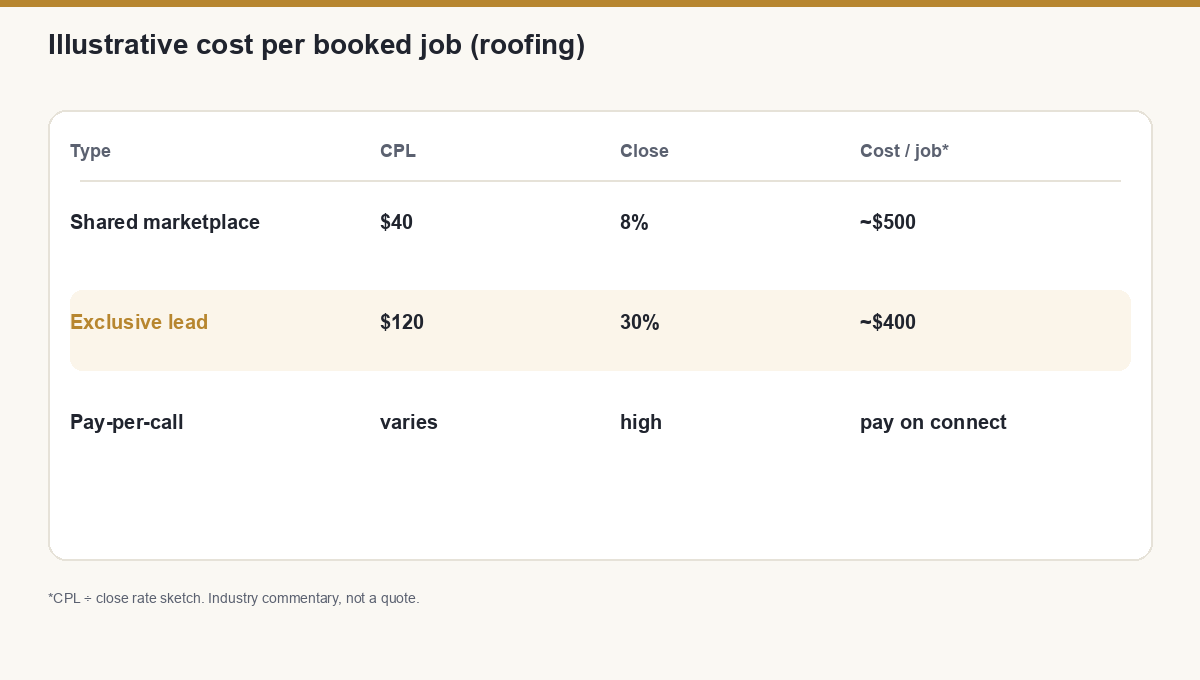
Shared marketplaces also train homeowners to expect five quotes and a price war. That dynamic can crush margins even when you “win” the job. Exclusive changes the conversation: you are often first, sometimes only, and you can sell process and warranty instead of racing the cheapest bid.
What exclusive should mean in home services
- One contractor receives the lead for the agreed window
- The homeowner requested your trade (roofing, not a vague “home project” quiz)
- Geo matches your service radius and crew map
- Delivery is fast enough to preserve first contact
- Consent capture and opt-out hygiene are real
Exclusivity without speed is half a product. An exclusive lead worked tomorrow morning is an exclusive lead you donated. Likewise, exclusivity without geo discipline means paying for drive time you will never recover.
Ask vendors to define the exclusive window in writing. “Exclusive while you are working it” is vague. Prefer clear windows (for example, exclusive for X hours/days) and clear replacement rules for bad numbers and out-of-area leads.
Formats contractors actually use
Exclusive form leads
Best for planned replacements, reroofs, and homeowners comparing options without an emergency. Form leads let your office control callbacks, SMS confirmation, and estimate scheduling. They fail when the intake process is slow or when the form intent is too soft (“free home evaluation” without roofing mention).
Require trade-specific intent language. A homeowner who asked for roofing repair is a different buyer than someone who entered a sweepstakes for a “home makeover.”
Pay-per-call
Pay-per-call works when you can answer the phone live and book estimates on the first conversation. Unit cost is higher; wasted spend is lower if your phones are staffed. It collapses when calls roll to voicemail during lunch or when untrained staff take messages without scheduling.
Define billable call rules carefully: duration, unique caller, geo match, and spam filters. Ambiguous billable definitions are how contractors feel overcharged even when lead quality is decent.
Storm and restoration spikes
After hail or wind events, demand spikes and so does bad inventory. Storm maps attract temporary media sellers and recycled lists. Exclusive storm leads can be valuable if geo is tight and intake is same-day. They are dangerous if you buy national storm dumps and hope your ZIP appears often enough.
- Pre-agree daily caps before weather hits
- Staff estimators and office phones for evenings
- Suppress closed jobs and exhausted contacts so you do not re-buy the same rooftops
- Revisit caps every week during peak season — crew availability changes faster than media plans
Compliance is not only an insurance issue
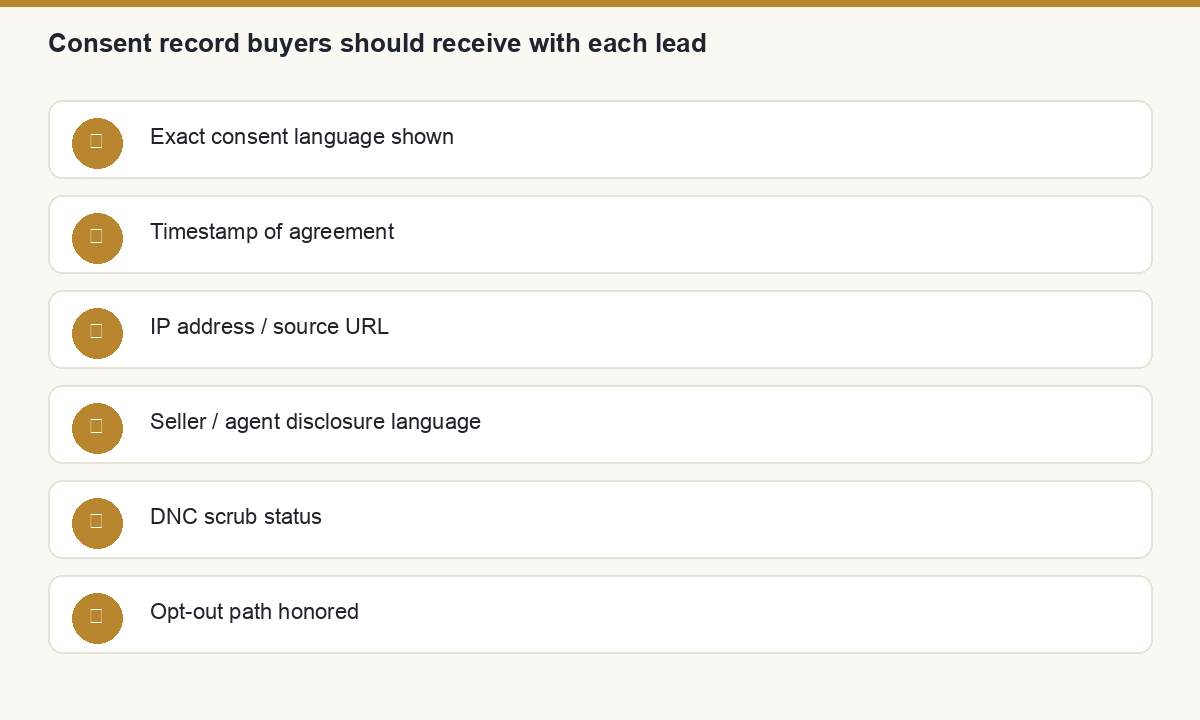
Home-services calling and texting still sit under TCPA-minded rules when you use automated dialing, SMS, or purchased leads. Contractors sometimes assume “we’re not insurance” means compliance is optional. It is not. Demand a consent packet with language, timestamp, source, and channel scope — details in our consent record guide.
SMS appointment reminders are useful and risky if the original consent did not cover text. Keep channel scope honest. Prefer manual processes or properly consented messaging tools.
How to run a roofing pilot correctly
A pilot program is paid, scoped, and time-boxed. Pick a tight service area, one primary format, and a daily cap your office can work. Freeze your estimate script and follow-up sequence so you measure inventory quality, not operational chaos.
Scorecard for a four-week pilot:
- Leads delivered vs worked same day
- Contact rate within two hours and within 24 hours
- Estimates set and estimates run
- Jobs sold and revenue booked
- Cost per booked job and cost per sold job
- Invalid / out-of-area rate
If cost per booked job beats your current shared marketplace or door-knock baseline with acceptable crew utilization, scale. If not, diagnose process before you blame the entire exclusive category.
Pair lead quality with estimate process quality. A perfect exclusive lead dies when the homeowner waits three days for a visit or never receives a confirmation text. Train CSRs the way you train installers.
Building a contractor scorecard that vendors respect
Serious vendors respond better when you report clean data. Share weekly invalid rates, out-of-area issues, and contact rates. Ask for source adjustments instead of only demanding discounts. Ten percent off the wrong ZIPs is not a win; better geo match is.
Define “worked” consistently. If one CSR marks everything contacted after a single ring, your vendor reporting becomes fiction. Standardize dispositions: no answer, left message, contacted, estimate set, not interested, wrong number, out of area.
Storm season playbook
Before storm season, document max daily estimates per crew, max drive radius, and backup CSR coverage. During events, protect reputation: do not overpromise timelines you cannot hit. Exclusive leads still create angry homeowners if you book and cancel repeatedly.
After events, clean your CRM. Suppress closed jobs and exhausted contacts. Review which ZIP clusters converted and which only generated tire-kickers. That learning should change next month’s geo filters — not sit in a forgotten spreadsheet.
Comparing exclusive vendors without getting lost
Do not compare vendors only on CPL. Compare:
- Exclusive definition and multi-sale controls
- Median delivery latency
- Geo precision (ZIP, radius, serviceability)
- Consent packet completeness
- Replacement policy speed
- Willingness to run a paid pilot with shared success metrics
Be cautious of vendors who only win on volume promises. Roofing is local. National volume means nothing if your trucks cannot reach the address profitably.
Estimating capacity before you buy another ZIP
Map weekly estimate slots honestly. Include weather delays, no-shows, and travel time. If your team can run twenty quality estimates a week, buying forty exclusive leads into the same week without CSR support creates the same chaos shared marketplaces create — only you paid more for the privilege.
Contractors who win with exclusive roofing leads treat marketing like dispatch: caps, territories, and feedback loops. Share invalid and out-of-area rates with vendors weekly. Ask for geo surgery, not only discounts. Over time, a tight ZIP list with strong intent beats a wide map with soft forms.
Also separate replacement roofs from repair intent when your average ticket differs sharply. Mixing them without tagging makes ROI conversations impossible.
CSR scripts that protect exclusive homeowner intent
The first human voice the homeowner hears often decides whether your exclusive lead becomes an estimate or a missed opportunity. CSRs should confirm the request, confirm the address serviceability, and offer two concrete appointment windows — not a vague “someone will call you back.” Exclusive inventory dies in voicemail tag more often than contractors admit.
Train a 60-second intake: who you are, why you are calling (reference the form), confirm roofing need, confirm decision-maker availability, book the estimate, send confirmation. If SMS is within consent scope, send the confirmation immediately. Homeowners shopping multiple contractors reward the company that reduces uncertainty fastest.
Record intake calls where lawful. Coach weekly. A $10 script improvement on exclusive leads can outperform a $5 CPL reduction on shared leads because it compounds across higher-intent traffic.
Job types, ticket size, and why one CPL does not fit all roofs
A repair lead and a full reroof lead are different products. If your average repair ticket cannot support premium exclusive CPL, either filter for replacement intent or run repairs on a different SKU and budget. Blended dashboards hide this. Tag leads by stated need whenever the form captures it.
Insurance restoration work adds another layer: cycle times, documentation, and homeowner expectations differ from retail reroofs. If your company is retail-first, do not buy storm insurance-intent inventory just because it is available. Fit beats FOMO.
For multi-trade home-services companies, keep roofing exclusive feeds separate from siding or windows unless the capture clearly allows multi-trade follow-up. Cross-sell without scope alignment creates both compliance risk and homeowner irritation.
Measuring marketing like a production manager
Contractors already measure production: squares per day, callbacks, warranty work. Apply the same seriousness to leads. Post a weekly board: exclusive leads in, estimates run, close rate, revenue, cost per sold job. When numbers move, ask whether media, weather, pricing, or crew capacity moved — not only “leads bad.”
Involve estimators in vendor feedback. They see roof condition claims versus reality. If a source systematically overstates urgency (“emergency leak” that is a cosmetic concern), that is a publisher quality issue worth escalating with examples, not vibes.
Finally, protect brand reviews. Exclusive contact still generates one-star reviews if scheduling is chaotic. Marketing and operations share the P&L whether the org chart admits it or not.
When to walk away from a shared marketplace entirely
If shared marketplace cost per booked job has been worse than exclusive for two full pilot cycles, and your office process is competent, stop treating shared as “backup strategy.” It may simply be a different business: high-volume price competition you do not want. Some contractors keep a tiny shared allotment for overflow; others exit entirely. Either choice should be conscious.
Walking away is easier when you have a pilot-backed exclusive relationship with clear geos and caps. Panic quitting shared without exclusive supply ready creates a lead drought. Sequence the transition: pilot exclusive, prove cost per booked job, then reduce shared deliberately.
Technology stack that keeps exclusive leads from leaking
Exclusive leads leak through slow CRM syncs, personal cell-phone side channels, and unlogged SMS. Use a single intake system of record. Push leads to the CSR queue automatically. Disable the habit of managers texting leads to estimators without dispositions. If it is not logged, it is not managed — and exclusive economics depend on management.
Integrate calendars for estimate booking. Reduce back-and-forth. The homeowner who booked in one call is less likely to take the shared-marketplace competitor’s appointment an hour later.
Pricing your response: when exclusive CPL is rational
Contractors often ask for “the best exclusive price” without sharing average job value. That conversation cannot end well. If your average sold job contributes $2,000 after materials and labor, a $120 exclusive lead at a 25% close rate is $480 media per sold job — potentially excellent. If your average job contributes $400, the same lead economics may be impossible.
Bring job-value bands to vendor conversations. Ask for geo performance ranges. Design pilots around ZIPs where your close history is strongest. Exclusive roofing leads are a margin tool, not a lottery ticket.
Watch seasonality in non-storm markets too. Spring replacement demand differs from mid-winter. Caps should flex with crew reality, not with a static annual PO that ignores weather and vacation calendars.
Partnering with canvass or retail without double-buying the same roof
Many roofing companies run canvass, retail stores, or builder relationships alongside digital leads. Without suppression, you will pay exclusive digital prices to re-contact homeowners already in your funnel. Sync addresses and phones across channels nightly if you can; weekly at minimum.
Define channel priority rules. If canvass booked an estimate, digital exclusive should not create a second CSR chase the next morning. Internal competition feels like shared marketplace chaos — even when every lead was “exclusive” at purchase.
Where Braqon fits
Braqon provides exclusive roofing and home-services leads — not shared marketplace pile-ons. New contractors start with a pilot program sized to office capacity, then expand monthly volume by service area. See Roofing leads, the US FAQ, and the US hub.
Bring your service ZIPs, average job value, and how many estimates your team can run per day. That is the input set for a pilot that measures cost per booked job — the number that actually pays trucks.